


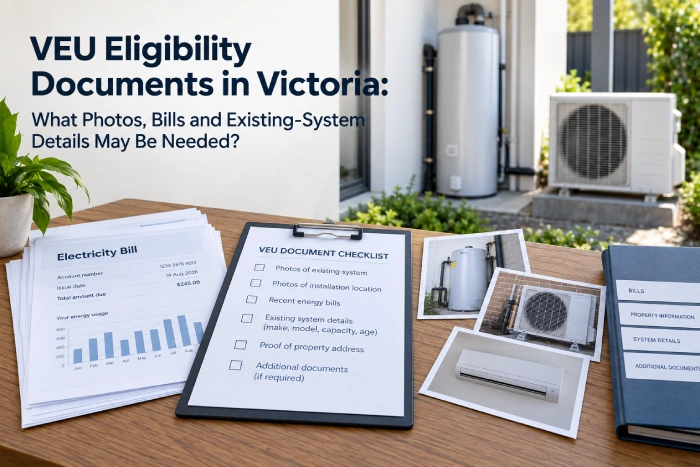
VEU Eligibility Documents in Victoria: What Photos, Bills and Existing-System Details May Be Needed?
When a Victorian household enquires about a VEU-supported hot water or air-conditioning upgrade, the provider may need more than just the property address and a description of the old system.
Existing equipment may need to be identified, the installation location may need to be documented, and evidence may be required before and after the upgrade. The exact records vary by VEU activity, so there is no single document checklist that applies to every property.
What documents may be needed for a VEU upgrade?
For a VEU hot water or heating-and-cooling upgrade, you may be asked for information such as:
- the property and installation address
- photos of the existing appliance
- photos showing the appliance location
- brand and model details where available
- serial number or compliance-plate information
- information about the existing system type
- invoice or proof-of-purchase records
- decommissioning evidence where an old appliance is removed
- electrical or plumbing compliance certificates where required
- photographs of the completed installation
Some of these records are normally collected by the accredited provider or installer rather than supplied entirely by the homeowner.
A recent electricity or gas bill is not a universal requirement across all VEU hot-water and heating-and-cooling activities. Whether a bill is useful or requested depends on the activity and provider process.
1. Start with clear photos of the existing system
Photos can be important because VEU activities may require evidence of what was installed before the upgrade.
The Essential Services Commission’s record-keeping guidance specifically refers to geo-tagged photographs for a number of VEU activities. For water-heating activities, minimum records can include photos showing the existing product before the upgrade, details of the new product and evidence of the completed installation.
Before an assessment, it may be useful to take clear photos showing:
- the whole existing unit
- its location within or outside the property
- the compliance plate or equipment label
- visible brand and model information
- nearby pipework or connections
- the surrounding installation area
Do not remove or dispose of the old system before the provider has confirmed what evidence is needed.
2. Why geo-tagged photos may matter
A normal photo and a VEU evidence photo are not always the same thing.
ESC guidance explains that geo-tagged photographs may be used to verify that the activity occurred at the relevant premises and that the existing and replacement products meet the applicable requirements. Geo-tagged images may contain date and GPS information in the image metadata.
This is generally something the accredited provider or installer should manage as part of the official process.
Homeowners should not assume that sending an ordinary photo by email will automatically satisfy all evidentiary requirements.
3. Record the existing system type accurately
Eligibility may depend heavily on what equipment is currently installed.
For hot water, the provider may need to understand whether the existing unit is:
- conventional electric storage
- gas storage
- gas instantaneous
- solar hot water
- another existing hot-water type
For heating and cooling, relevant information may include whether the home currently has:
- ducted gas heating
- a non-ducted gas heater
- electric resistance heating
- evaporative cooling
- refrigerative cooling
- an existing reverse-cycle system
- no eligible system being decommissioned
The applicable VEU pathway can change depending on the existing equipment and proposed replacement.
Current Victorian heating-and-cooling guidance also requires an approved high-efficiency reverse-cycle product, with additional conditions applying when an existing system is being replaced.
4. Photograph the compliance plate where possible
The compliance or product label can help identify:
- manufacturer
- model number
- serial number
- equipment type
- other technical information
A clear close-up photo can save time if the product details are difficult to read during an initial phone or online assessment.
If the label is damaged or unreadable, the provider may need other evidence to establish what the existing product is. ESC guidance for relevant activities allows manufacturer documentation or data sheets to be used in some circumstances where an existing-product compliance plate cannot be read.
5. Do you need to provide an electricity or gas bill?
Not necessarily.
There is no safe basis for telling every hot-water or air-conditioning customer that a recent electricity or gas bill is mandatory for VEU eligibility.
A bill may still be useful in some situations because it can help confirm information such as:
- the property or account details
- existing tariff arrangements
- controlled-load hot water
- gas supply
- household energy-use context
But whether it forms part of the actual evidence required should be confirmed by the accredited provider.
This distinction is important because evidentiary requirements can change. For example, Victoria removed a recent gas-bill/LPG-invoice evidentiary requirement from the induction-cooktop activity in June 2026, illustrating why older generic document lists should not be applied automatically to every VEU activity.
6. Invoices and proof of purchase may form part of the record
Current Victorian guidance says invoices or proof of purchase may be required, depending on the appliance.
These records can be used to show information such as:
- product brand and model
- purchase or installation date
- consumer details
- installation address
- product price
- amount paid
The ESC’s VEU guidelines contain detailed record-keeping requirements for accredited providers and activity participants.
In a standard VEU installation arranged through an accredited provider, much of this paperwork should be incorporated into the provider’s process.
7. Decommissioning evidence may be important
Where an activity involves replacing an existing eligible appliance, the old system may need to be decommissioned in accordance with the applicable rules.
Evidence can include:
- before-upgrade photographs
- evidence showing the old system has been decommissioned
- relevant plumbing or electrical records
- information identifying the old appliance
The exact requirement depends on the activity.
This is another reason not to arrange separate removal of the old appliance before the VEU provider has assessed the property.
8. Compliance certificates may be required after installation
Depending on the work performed, the VEU record may include relevant:
- electrical certificates
- plumbing compliance certificates
- other legally required installation records
The current Victorian heating-and-cooling consumer process states that accredited providers or their installers handle the paperwork associated with the upgrade, including applicable electrical or plumbing certificates.
Homeowners should still keep copies of the documentation they receive after installation.
9. You should also receive the relevant consumer factsheet
VEU rules require consumers undertaking certain activities to receive current program information before agreeing to the upgrade.
The Victorian Government lists mandatory consumer factsheets for:
- the overall VEU scheme
- space heating and cooling
- water heating
- other applicable activities
For water-heating and space-heating/cooling upgrades, the consumer must also receive information about product suitability and sizing before agreeing to proceed.
If you are being asked to sign before you understand what is being installed, ask for the relevant information first.
10. Prepare a simple folder before requesting an assessment
You do not need to build a formal VEU evidence package yourself.
A useful starting folder can contain:
- property address
- homeowner or landlord contact details
- clear photos of the existing appliance
- compliance-plate photo
- brand and model where known
- approximate installation age where known
- information about whether the property is rented
- any relevant existing-system paperwork
- energy bill only if requested or helpful
- questions about the proposed replacement
The provider can then tell you which information is actually required.
Why speak with Auzbright?
Auzbright supports Victorian households considering heat pump hot water and reverse-cycle air-conditioning upgrades and appears on current Victorian Government provider listings for VEU activities.
Rather than guessing which documents apply, Auzbright can help identify the relevant upgrade pathway and explain what evidence may be required before installation.
Final CTA
If you are preparing for a VEU-supported hot water or air-conditioning upgrade in Victoria, contact Auzbright before collecting unnecessary paperwork.
The team can review your existing system, explain what photos or product details may be useful and confirm the current evidence requirements for the proposed upgrade.
FAQs
Do I need photos of my old appliance for a VEU upgrade?
Photos of the existing product are commonly part of VEU evidence requirements for relevant replacement activities. The accredited provider should tell you what photos are required and manage any official geo-tagging requirements.
Do VEU photos need to show the model number?
Product-identification details may be needed. A clear photograph of the compliance plate, brand, model or serial information can be useful where available.
Do I need to provide my electricity or gas bill?
Not for every VEU activity. Bills may be useful in certain assessments, but they should not be treated as a universal requirement unless the provider or current activity rules require them.
Who completes the VEU paperwork?
Accredited providers manage the discount process and associated paperwork. Installers working with an accredited provider may also collect required records and return completed forms to the provider.
Can I remove my old heater or hot water system before the assessment?
It is better to check first. If the upgrade relies on evidence of an existing product or its decommissioning, removing it before the required evidence is collected may complicate the VEU process.