


Air Conditioning Upgrades for Derrimut Homes with Older Gas Heating: What to Assess Before Switching
An older gas heater may still produce warmth, but it may no longer suit the way your household uses the home. Some rooms may remain cold, the system may need frequent repairs, or you may want one solution that provides both heating and cooling.
Auzbright is based in Derrimut and helps households review energy-efficient heating and cooling options. Before switching, the aim should be to understand what your home needs rather than simply replacing one system with another.
Direct Answer: What should homeowners assess before switching?
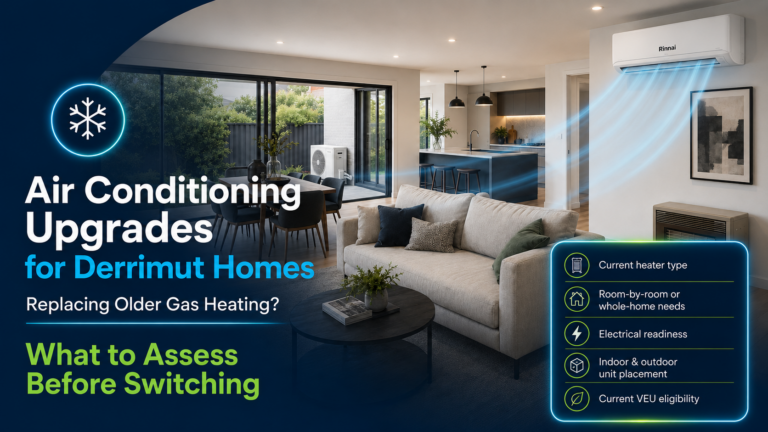
Before replacing older gas heating with air conditioning, homeowners should identify the current heater type, decide whether they need room-by-room or whole-home comfort, review insulation and room usage, check electrical readiness, plan indoor and outdoor unit locations, understand decommissioning requirements and confirm current VEU eligibility.
Reverse-cycle air conditioning may suit many homes, but the system and installation should be selected for the individual property.
1. Identify the gas-heating system you already have
The first step is to understand what will be replaced.
Your home may currently use:
- ducted gas heating
- a non-ducted gas room heater
- a wall furnace
- several separate gas heaters
- gas heating combined with older cooling units
- a system that heats only part of the property
The current setup affects which reverse-cycle options may be practical and what work may be required.
For example, replacing one room heater may lead to a different solution from replacing whole-home ducted gas heating. The quote should clearly identify the existing system and explain what will be removed, disconnected or retained.
2. Decide whether you need targeted or whole-home comfort
Not every household needs the same air-conditioning arrangement.
A homeowner who mainly uses the living room and one bedroom may prefer targeted split systems. A larger household that regularly uses several rooms may consider a multi-head or ducted solution.
Household Need | Option Worth Reviewing |
One main living area | Single-split reverse-cycle system |
Several regularly used rooms | Multiple splits or a multi-head system |
Integrated whole-home comfort | Ducted reverse-cycle air conditioning |
Different comfort needs across areas | Zoned or room-by-room control |
This is not a universal recommendation. Home layout, budget, available space and installation conditions should guide the choice.
3. Review which rooms actually need heating and cooling
Older gas systems are often designed around a fixed whole-home or single-room approach. Before replacing the system, consider how the property is used now.
Ask:
- Which rooms are occupied every day?
- Are bedrooms mainly used at night?
- Does anyone work from home?
- Are some areas rarely occupied?
- Is the living area open plan?
- Does the upstairs level behave differently from downstairs?
- Are there rooms that become particularly hot in summer?
- Will household usage change in the next few years?
This helps prevent over-planning or installing a system that does not match daily routines.
4. Assess insulation, draughts and window exposure
A new air conditioner should not be expected to solve every comfort problem on its own.
Poor insulation, large areas of glass, draughts, direct afternoon sun and open staircases can affect how a home heats and cools. These factors may influence system selection and room-by-room performance.
Before approving an upgrade, it may be useful to review:
- ceiling and wall insulation
- gaps around doors and windows
- window orientation
- curtains or shading
- room size and ceiling height
- open-plan areas
- air movement between levels
The objective is to select a suitable system while also recognising features of the home that may affect comfort and energy use.
5. Check electrical readiness
Switching from gas heating to electric reverse-cycle air conditioning may change the home’s electrical requirements.
Depending on the selected system and existing property setup, the installer may need to review:
- switchboard condition
- available electrical capacity
- dedicated circuits
- wiring routes
- meter or supply considerations
- the location of indoor and outdoor units
- whether additional electrical work is required
Not every property will need major electrical changes. However, electrical requirements should be checked before the final quote is accepted.
6. Plan outdoor-unit placement carefully
Reverse-cycle systems generally require outdoor equipment. Its placement should be considered early, especially for properties with limited side access or neighbouring homes nearby.
The assessment should consider:
- safe installer access
- suitable airflow
- space around the unit
- distance from bedrooms and living areas
- proximity to neighbours
- visibility from the street
- pipework routes
- future servicing access
- owners-corporation rules where relevant
Product-specific installation requirements should be confirmed for the selected model rather than estimated from a general advertisement.
7. Understand what happens to the gas heater
Homeowners should ask what decommissioning or removal work forms part of the proposed upgrade.
The quote should explain:
- whether the old heater will be removed
- whether it will be disconnected or left in place
- what happens to existing ducts or vents
- whether gas-related work is included
- whether wall or floor openings need attention
- whether certificates will be supplied
- whether separate trades or costs may apply
Do not assume that installing the new air conditioner automatically includes every part of removing the old gas-heating system.
8. Check current VEU eligibility
Eligible Victorian households may be able to access support for approved reverse-cycle air-conditioning upgrades under the Victorian Energy Upgrades program.
However, eligibility and the applicable upgrade pathway depend on current program requirements, the existing heating system, the proposed replacement, approved products and installation details.
Current requirements should be confirmed before proceeding. Homeowners should not assume:
- every gas-heated home receives the same support
- every reverse-cycle model is eligible
- the same discount applies to all properties
- approval is automatic
- an advertised amount will be the final out-of-pocket price
Auzbright can help Derrimut homeowners understand available pathways and identify the information needed for an eligibility assessment.
9. Compare the full quote
The lowest headline price may not represent the same installation scope as another proposal.
Before accepting a quote, check whether it includes:
- the proposed air-conditioning system
- indoor and outdoor units
- standard installation
- electrical work
- pipework and drainage
- brackets or mounting
- removal or decommissioning of the gas heater
- duct, vent or zone requirements
- certificates and paperwork
- VEU assessment where relevant
- exclusions and possible additional costs
A complete quote should also explain why the recommended system suits the property.
10. Consider whether other gas appliances will remain
Replacing gas heating does not necessarily mean the home will stop using gas entirely. The property may still have gas hot water, cooking or other appliances.
Before making broader decisions about the gas connection, confirm:
- which gas appliances remain
- whether they will be replaced now or later
- whether the household is planning staged electrification
- whether supply charges remain relevant
- whether solar or future electrical upgrades are planned
This avoids treating one air-conditioning upgrade as though it automatically changes the whole property’s energy setup.
Why speak with Auzbright in Derrimut?
Auzbright is based in Derrimut VIC 3026 and supports households considering more efficient heating and cooling upgrades.
For homeowners with older gas heating, Auzbright can help review:
- the existing heater
- room and household needs
- suitable reverse-cycle options
- installation access
- electrical considerations
- quote inclusions
- current eligibility pathways
The aim is to select an option that suits the home rather than recommending the same system for every property.
Final CTA
If your Derrimut home has older gas heating and you are considering reverse-cycle air conditioning, contact Auzbright for a property-specific discussion.
Auzbright can help assess your existing system, home layout, heating and cooling needs, installation requirements and current VEU upgrade options before you decide.
FAQs
Does Auzbright help homeowners with air-conditioning upgrades in Derrimut?
Yes. Auzbright is based in Derrimut and helps households explore air-conditioning and heating upgrade options based on their property and current system.
Can reverse-cycle air conditioning replace gas heating?
It may be able to replace some room-based or whole-home gas-heating systems. The suitable approach depends on the existing heater, property layout, system design and installation requirements.
Should I choose split systems or ducted air conditioning?
Split systems may suit targeted rooms, while ducted air conditioning may suit integrated whole-home comfort. Multi-head systems may be considered where several rooms need individual indoor units connected to one outdoor unit.
Can Derrimut households access VEU support for replacing gas heating?
Some Victorian households may be eligible for support for approved reverse-cycle upgrades. Current eligibility depends on the existing system, selected product, installation and program requirements.
Will switching from gas heating reduce my energy bills?
It may change household energy use, but results vary according to system efficiency, tariffs, usage, insulation, property layout and whether other gas appliances remain. Fixed savings should not be assumed.