


Replacing Evaporative Cooling with Reverse-Cycle Air Conditioning in Western Melbourne: What Changes?
An evaporative cooler and a reverse-cycle air conditioner may both cool a home, but they work very differently. Replacing one with the other is therefore more than simply swapping the outdoor unit.
Auzbright is based in Derrimut and supports western Melbourne households considering efficient air-conditioning upgrades. If an older evaporative cooler is no longer meeting your needs, the first step should be assessing the existing system and the rooms you want the replacement to serve.
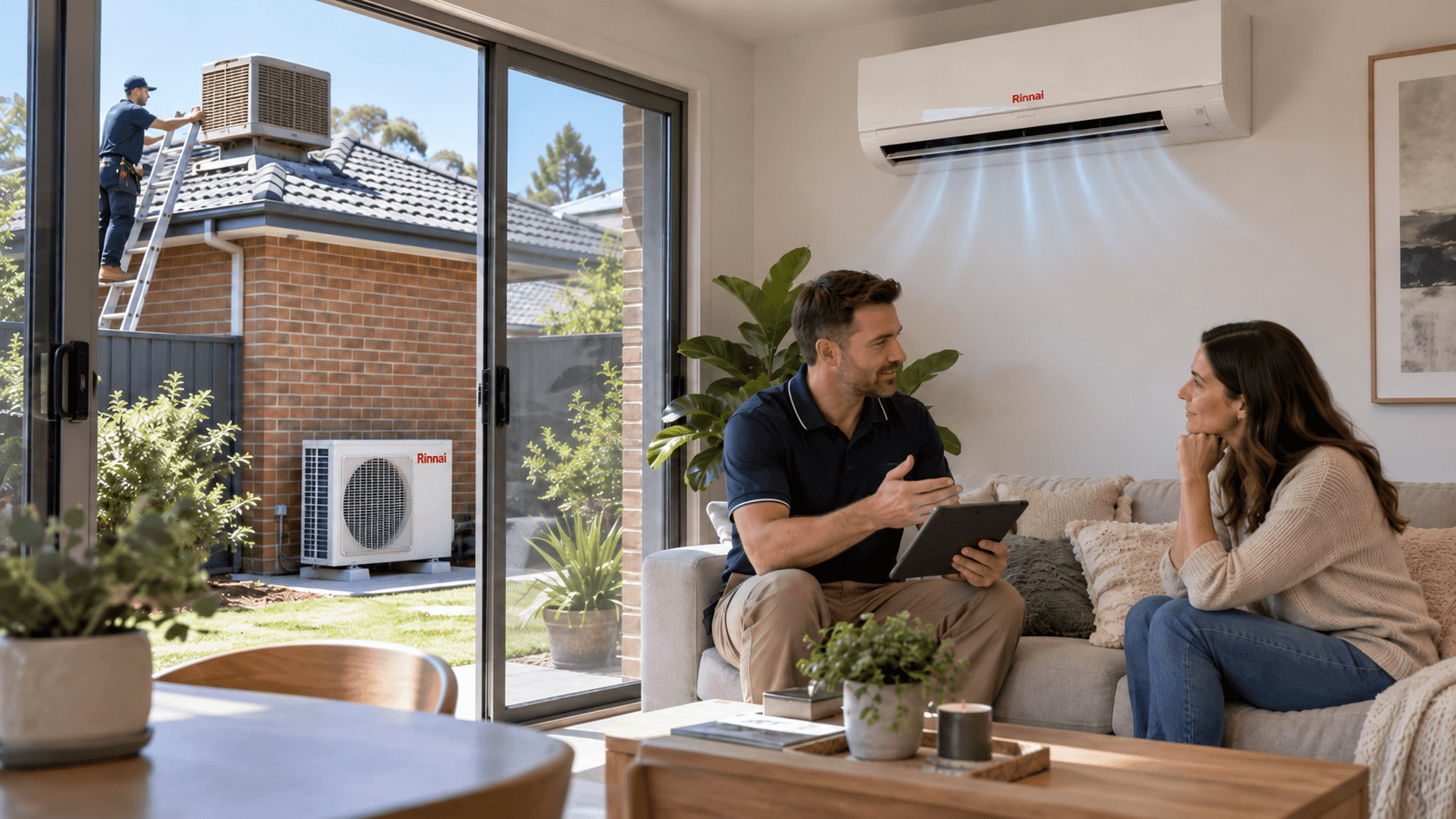
Direct Answer: What changes when you replace evaporative cooling with reverse-cycle air conditioning?
Replacing evaporative cooling with reverse-cycle air conditioning changes both how the home is cooled and how the system is designed.
An evaporative cooler generally draws outside air through wet filter pads and distributes that cooled air through ducts. Reverse-cycle air conditioning uses a refrigerant-based system that can provide both cooling and heating.
Depending on the property, switching may involve new or modified ducting, indoor units, an outdoor unit, electrical work, drainage, controls and removal or isolation of the existing evaporative system.
The existing evaporative ducts should not be assumed to be suitable for the new reverse-cycle system. The replacement design needs to be assessed for the individual home.
1. Decide whether you want cooling only replaced or a new heating-and-cooling solution
The first question is what you expect from the new system.
An evaporative cooler generally addresses summer cooling. Reverse-cycle air conditioning can provide both heating and cooling.
That creates an opportunity to review the home’s entire comfort setup rather than replacing cooling in isolation.
Consider:
- what currently heats the home in winter
- whether the existing heater will remain
- which rooms need regular heating and cooling
- whether bedrooms need separate control
- whether the home has open-plan living areas
- whether different household members prefer different temperatures
Current Victorian guidance identifies single-split, multi-split and ducted reverse-cycle systems as available options, with suitability depending on the household and property.
2. Do not assume the evaporative ducts can simply be reused
This is one of the most important questions to ask.
An existing evaporative system may already have:
- ceiling ducts
- roof-space ductwork
- supply vents
- an outdoor or roof-mounted cooling unit
That does not mean those components automatically suit reverse-cycle air conditioning.
The two system types operate differently, and the replacement may have different requirements for:
- duct sizing
- insulation
- sealing
- air volume
- return air
- zoning
- vent locations
Even Victorian guidance for reverse-cycle ducted systems advises homeowners to discuss existing ducting with the installer because older ducting may need upgrading.
A quote should clearly identify what will be retained, replaced or removed.
3. Choose between splits, multi-split and ducted reverse cycle
Replacing ducted evaporative cooling does not automatically mean you need ducted reverse-cycle air conditioning.
Depending on the home, three broad options may be worth assessing.
Option | May Suit |
Single-split systems | Individual rooms or main living spaces |
Multi-split system | Several rooms using multiple indoor units connected to one outdoor unit |
Ducted reverse cycle | Homes seeking an integrated whole-home heating and cooling system |
A household that uses only a living area and two bedrooms may reach a different decision from a family that regularly uses every room.
The system should be chosen around actual room usage, layout and comfort expectations rather than simply matching the previous evaporative system.
4. Review the ceiling and roof space
Evaporative systems often use roof-mounted equipment and ceiling ducts, so the replacement assessment should include the roof and ceiling areas.
Questions may include:
- What happens to the existing evaporative unit?
- Will old ducts remain or be removed?
- Is there sufficient roof space for new ducting?
- Where would a ducted indoor unit be positioned?
- Is return-air space available?
- Are there existing insulation, wiring or access constraints?
- Will roof penetrations from the old system need attention?
If split systems are selected instead, the design may rely less on existing roof ductwork but require suitable wall positions and refrigerant pipe routes.
The final scope should be explained before installation begins.
5. Check outdoor-unit placement
Reverse-cycle systems generally require outdoor condenser equipment.
Before choosing the system, the installer should review:
- available outdoor space
- airflow
- installer access
- servicing access
- distance from bedrooms
- neighbouring properties
- pipe routes
- drainage
- multiple outdoor units where relevant
This can be especially important where several split systems are being considered.
Do not select a system solely from an indoor-unit brochure without understanding where all required outdoor equipment will be installed.
6. Assess the electrical setup
Moving from evaporative cooling to reverse-cycle air conditioning may change the property’s electrical requirements.
Depending on the selected system, the assessment may include:
- switchboard condition
- available circuit capacity
- dedicated circuits
- wiring routes
- isolation requirements
- existing electrical loads
- future heat pump, solar, battery or EV plans
Not every property will need a switchboard upgrade, and the same electrical work does not apply to every installation.
Any required electrical work should be identified by the appropriately qualified professional and included clearly in the quote.
7. Think about zones and room control
One potential advantage of designing the replacement from scratch is that the system can be matched more closely to how the household uses different rooms.
With suitable systems, homeowners may be able to plan separate rooms or zones rather than treating the entire property as one area.
For example, a family may want:
- living areas during the day
- bedrooms in the evening
- a home office during working hours
- selected areas left off when unused
Victoria’s reverse-cycle guidance recommends zoning for suitable ducted installations because it allows households to control which parts of the home are heated or cooled.
The available controls depend on the selected system, so model-specific features should be confirmed before purchase.
8. Can filtration be added while the home is occupied?
Removal should be discussed before accepting the quote.
Ask whether the proposed work includes:
- disconnecting the old system
- removing the roof-mounted unit
- removing or retaining ductwork
- dealing with old vents
- electrical disconnection
- water connection changes
- roof or ceiling rectification
- disposal of equipment
Some of these tasks may fall outside a standard air-conditioning installation quote.
The provider should explain exactly what is included and what may require another trade.
9. Check current VEU support carefully
Efficient reverse-cycle air conditioners are currently supported through Victorian Energy Upgrades where applicable program requirements are met. Current guidance requires an approved high-efficiency reverse-cycle system providing both heating and cooling, and the existing system must be more than two years old where a heating or cooling system is being replaced.
However, homeowners replacing an evaporative cooler should not assume that their existing cooler creates the same VEU replacement pathway as an old gas or electric resistance heater. The current public discount table lists several existing-system scenarios and also includes installations without a decommissioned eligible product, so the appropriate pathway should be confirmed for the proposed installation before relying on a discount.
Auzbright is currently listed by the Victorian Government among accredited providers for heating and cooling upgrades.
10. Compare the complete replacement quote
A useful quote should explain the complete transition from the old cooling system to the new one.
Check for:
- proposed system type
- number of indoor units or zones
- outdoor equipment
- ductwork
- return air where applicable
- electrical work
- drainage
- old-system removal
- roof or ceiling work
- controls
- commissioning
- certificates
- VEU treatment where applicable
- exclusions and additional costs
Comparing only the headline equipment price can hide substantial differences in installation scope.
Why speak with Auzbright?
Auzbright is based in Derrimut and supports western Melbourne homeowners considering reverse-cycle air-conditioning upgrades.
For a property with evaporative cooling, Auzbright can help review the existing system, room requirements, replacement options, installation conditions and current Victorian upgrade pathways before a system is selected.
Final CTA
If your western Melbourne home has an older evaporative cooling system and you are considering reverse-cycle air conditioning, contact Auzbright for a property-specific assessment.
The team can help you compare split, multi-split and ducted options, understand what may change during installation and review the available upgrade pathway before you proceed.
FAQs
Can evaporative cooling be replaced with reverse-cycle air conditioning?
Yes, but it is normally a system redesign rather than a direct equipment swap. Ducting, electrical work, indoor and outdoor equipment, controls and removal requirements may all need assessment.
Can existing evaporative ducts be used for ducted reverse-cycle air conditioning?
They should not be assumed to be suitable. Existing duct dimensions, insulation, sealing and layout need to be assessed against the requirements of the proposed reverse-cycle system.
Is ducted reverse cycle the only replacement for ducted evaporative cooling?
No. Depending on the home, homeowners may consider single splits, multiple splits, a multi-split system or ducted reverse-cycle air conditioning.
Will I need to upgrade my switchboard?
Not necessarily. Electrical requirements depend on the existing property and selected system, so the switchboard and circuits should be assessed before installation.
Can replacing evaporative cooling receive a VEU discount?
A reverse-cycle installation may be able to access VEU support where current program requirements are met, but the applicable pathway depends on the proposed installation and existing equipment. Eligibility and the available discount should be confirmed before proceeding.